Introduction: The Fifteen-Year Tithe On Earth, the lottery is marketed as a civic privilege, a rite of passage wrapped in patriotic bunting and corporate tax breaks. When you turn eighteen, your name enters the drum. If your number is called, you surrender fifteen years of your youth to the orange gloom of Titan.
The math is simple, brutal, and absolute. Five years in a cryo-pod on the long haul past the asteroid belt, dreaming of nothing while your metabolism slows to a glacial crawl. Five years awake in the heated, pressurized warrens of Kraken Station, dredging liquid methane from the hydrocarbon seas, scraping organic sludge from the intake vents, and keeping the thermal cores burning against a surface temperature of minus two hundred and ninety degrees. Five years in the box on the return trip. You leave as a teenager with unformed ambitions and return at thirty-three with a government pension, a slight limp from prolonged low-gravity exposure, and ten years missing from the calendar of everyone you ever loved.
They call it the Tithe. Nobody refuses it, because the alternative is the crowded, flooded sprawl of the coastal slums where the air tastes like rust and the water is rationed by the thimble.
Out on Saturn’s largest moon, beneath a suffocating sky of nitrogen and methane haze, the colony runs on predictable variables. Thermal output, oxygen scrubbers, shift rotations, and the steady, rhythmic thrum of the distillation pumps. Everything is accounted for. Every gram of mass that enters the airlocks is weighed, logged, and assigned a serial number.
There is no room for anomalies in a closed system. Because in a closed system, an anomaly doesn't just break the rules—it breaks the math. And when the math fails on Titan, the cold gets in.
Chapter 1: Sub-Level Four
The grease in Manifold 9 smelled like burnt almonds and dead skin, a combination Aris had stopped noticing somewhere around month fourteen of his rotation.
He wedged his shoulders deeper into the narrow maintenance crawlspace beneath the primary water-reclamation deck, his headlamp cutting a harsh white cone through the gloom. Above his head, the heavy steel grating hummed with the vibration of thousands of gallons of greywater rushing through the filtration turbines. Down here, in the space between the structural hull and the deck plates, the air was thick, warm, and tasted faintly of copper.
"How’s the seal looking, Vance?" a voice crackled through his earpiece. It was Mara, watching the pressure schematics from the telemetry booth two decks up.
"Corroded," Aris grunted, wiping a smear of black condensation from his cheek with the back of a gloved wrist. "Someone slapped a temporary polymer patch on this joint three shifts ago and didn't log it. If it blows, we’re going to have an indoor swimming pool in Hydroponics."
"Don't threaten me with a good time. Just weld the seam and get out of there. Shift change is in twenty minutes, and the mess hall actually has real protein tonight."
Aris reached for his plasma torch, his fingers brushing the cold composite of his tool belt, when his headlamp caught something pale wedged behind the secondary ballast pipe.
He froze. The beam of light trembled slightly against the curved metal.
It was a boot. Standard-issue, steel-toed, scuffed across the synthetic leather—except it wasn't attached to anyone standing up. It was angled awkwardly, toes pointing straight down toward the sub-flooring.
"Mara," Aris said, his voice dropping an octave. "Hold on. I've got... someone's down here."
"Down there? Nobody's cleared for Sub-Level Four except you. Did one of the rookies drop a dummy?"
Aris didn't answer. He unclipped his safety tether, exhaled sharply to compress his chest, and squeezed himself sideways between the ballast pipe and a bundle of thick insulated conduits. The space narrowed until his ribs scraped against the hull plating. He pushed forward, his breath loud and ragged in his own ears, until he cleared the obstruction and dropped into the drainage trough.
The body was curled on its side in the dry basin, limbs tucked loosely against its chest as if it had simply lain down to sleep. The man was wearing the grey utility coveralls of a structural tech, the fabric pristine—no grease stains, no tears, no dust from the crawlspace.
Aris scrambled closer, his heart hammering against his sternum. He grabbed the man’s shoulder and rolled him onto his back.
The head lolled limply. The eyes were open, staring blindly at the underside of the deck grating, the pupils wide and fixed. The skin was pale, cool to the touch, with a faint bluish tint gathering along the jawline and ears.
"Mara, I have a code black," Aris said, his throat suddenly dry. "Sub-Level Four, junction nine-B. Send medical and security. Now."
"Vance, what are you talking about? Who is it?"
Aris leaned closer, aiming his headlamp directly at the dead man’s face, squinting past the shock to register the features. A sharp, narrow nose. A faint crescent scar just below the left eyebrow. A cluster of dark freckles across the bridge of the cheeks.
Aris stared. The breath caught in his lungs, sharp as broken glass.
"It's Julian," Aris whispered. "Julian Mercer. From Hab-Block C."
Silence stretched over the comms for three full seconds, filled only by the low, rhythmic hiss of the air scrubbers.
"Aris," Mara said, her voice strangely flat. "Look at the camera feed I'm pushing to your wrist display. Look at it right now."
With a shaking hand, Aris raised his left arm and tapped the small biometric screen strapped over his cuff. The grainy, wide-angle feed from the Hab-Block C common room flickered to life.
There, sitting at a scarred metal table beneath the fluorescent strips, was Julian Mercer. He was laughing at something across the table, leaning back in his chair with a mug of synthetic coffee in his hand, alive and entirely whole.
Aris looked down at the corpse lying in the grease at his feet. He looked back at the screen on his wrist. The crescent scar below the left eyebrow was identical. The pattern of freckles was identical. Even the way the dark hair curled slightly over the left ear was an exact, impossible mirror.
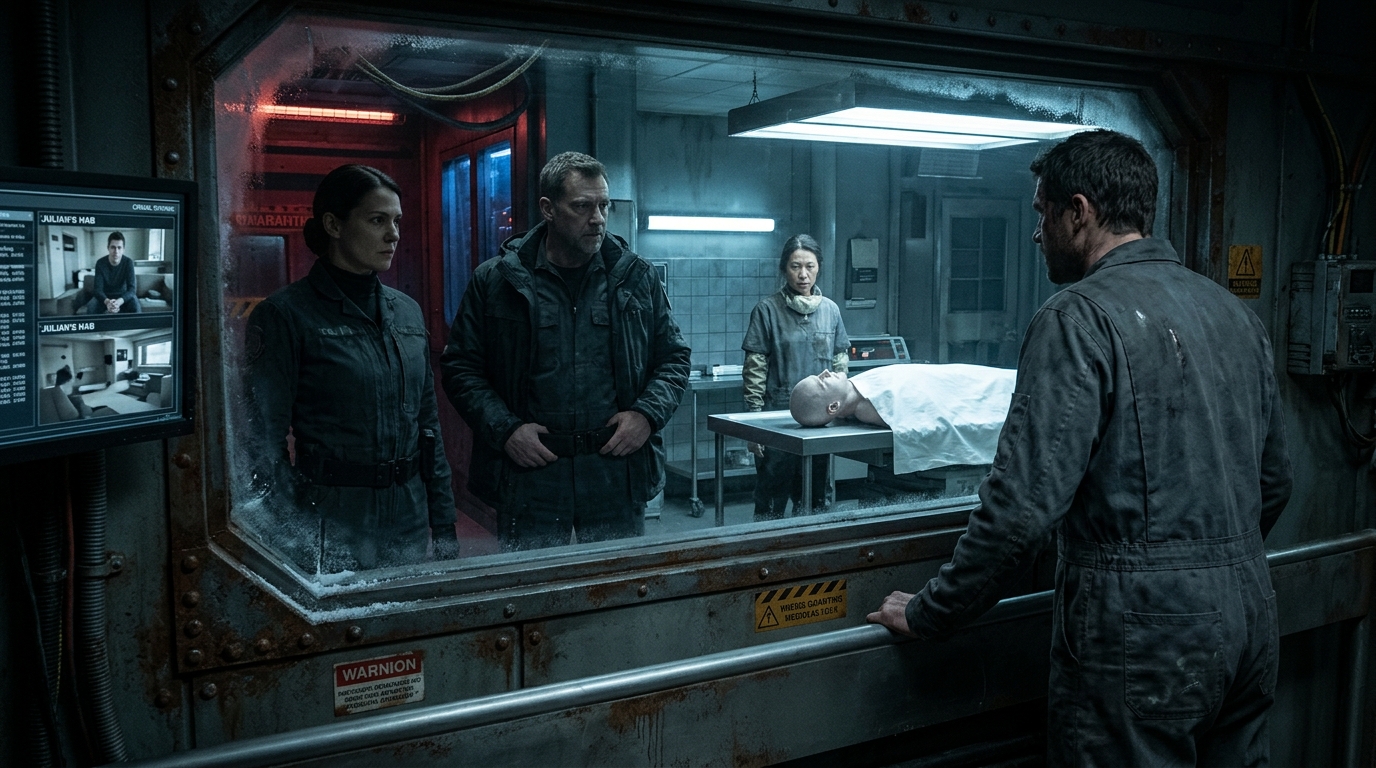
Three hours later, the medical bay on Level Two was sealed under a Level-One quarantine protocol, though Dr. Lin couldn't actually explain what they were quarantining against.
Director Thorne stood behind the glass partition of the surgical suite, his arms crossed tightly over his chest, watching the autopsy through the reinforced pane. Beside him stood Aris, still in his grease-stained coveralls, and Chief of Security Miller, whose hand hadn't left the butt of his stunner since they’d hauled the body up through the freight elevator.
Inside the brightly lit room, Dr. Lin peeled off her surgical gloves and dropped them into the bio-hazard chute. She walked over to the intercom panel and pressed the button, her face drawn and grey beneath the harsh overhead LEDs.
"Well?" Thorne demanded, his voice booming through the speaker. "Is it a synthetic? A corporate spy rig?"
"No," Dr. Lin said. She looked back toward the stainless-steel table where the body lay covered to the chest by a white sheet. "There are no mechanical components. No neural lace, no synthetic polymers, no micro-circuitry. He has a fully functioning—or rather, recently functioning—human cardiovascular system, digestive tract, and central nervous system."
"Then it's a clone," Miller said harshly. "Someone smuggled a flash-grown vat body onto the last supply freighter."
"Flash-clones have telomere degradation and zero epigenetic markers," Lin countered, her voice rising slightly with an edge of genuine panic. "I just ran a full genomic sequence and compared it to Mercer's intake file from Earth. It isn't just a genetic match, Director. It's the exact same biological timeline. This body has the exact same scar tissue on the left tibia from a childhood bicycle accident. It has the exact same dental fillings—with the exact same microscopic wear patterns on the molars. It has the exact same gut microbiome."
Thorne stared through the glass, his jaw clenching until a muscle pulsed beneath his ear. "That's impossible. Conservation of mass, Doctor. You don't just duplicate a hundred and seventy pounds of human tissue out of thin air."
"I'm telling you what's on my table," Lin said softly. "And there's something else. I can't find a cause of death."
Miller frowned. "Heart failure? Aneurysm? Asphyxiation?"
"Nothing," Lin said, shaking her head. "His lungs were full of oxygen. His coronary arteries are completely clear. There is no trace of toxin in his bloodstream, no brain hemorrhage, no cellular trauma. His organs didn't fail, Director. Every single cell in his body simply... stopped. All at the exact same microsecond."
Aris shifted his weight, feeling a cold sweat prickle along the back of his neck. He looked down the corridor toward the residential wings, thinking of the four thousand people sleeping in their bunks, breathing recycled air, trusting the walls to hold back the void.
"What about Mercer?" Aris asked quietly. "The real one. Does he know?"
"We haven't told him," Thorne said, his eyes never leaving the sheet-draped figure behind the glass. "We put him under passive observation in his quarters. Until we know how a man can walk into the mess hall at eighteen-hundred hours while his own corpse is cooling in a drainage pipe two decks below him, nobody says a word."
Miller uncrossed his arms, looking from the body to the locked doors of the med-bay. "And if it happens again? To someone else?"
Nobody in the room answered him. Out beyond the thick concrete hull, the Martian wind howled silently against the steel, and for the first time since his cryo-pod had thawed, Aris felt the crushing weight of forty meters of red rock pressing down directly over his head.
Chapter 2: The Double
The passive surveillance feed in Director Thorne’s office was the only thing in the entire colony that didn’t make a sound, and yet it felt like a siren.
Julian Mercer—the one from the residential block—was currently eating a lukewarm bowl of synthetic protein in the Hab-Block C mess hall. He had a slight, nervous habit of tapping his spoon against the side of his tray. On the monitor, he was doing it now: tap, tap, tap. A perfectly normal, slightly annoying gesture from a tired twenty-year-old nineteen months into a five-year shift.
"We can’t keep him in the dark, Thorne," Aris said, lean and tense against the steel bulkhead of the Director's office. He hadn’t washed the grease from his hands, and the copper smell of the sub-flooring seemed to have settled into his skin. "The crew is going to notice the quarantine on Medical. They're going to see the security patrols."
"We tell them it’s a standard bio-hazard drill," Chief Miller grunted, his fingers restlessly tracing the edge of his tablet. "If we tell four thousand people we found a dead clone of a living crew member in the drainage shafts, we will have a riot by shift change. You think eighteen-year-olds in a fifteen-year cage are stable? They’re one rumor away from tearing this station apart."
"It isn't a clone," Dr. Lin’s voice came over the speaker, flat and exhausted. She had been in the sealed medical lab for six hours. "Clones don't come out of a vat with a childhood scar from a bicycle accident in Toledo. Clones don't have matching dental fillings from a clinic in Ohio three years before they ever boarded the outbound haul. Miller, they share the exact same biological age. They have the same micro-abrasions on their skin. Down to the molecular level, they are the same person."
"Explain it then," Thorne said, not looking at her, his eyes locked on the live feed of Julian tapping his spoon. "Give me a theory that doesn't sound like a ghost story."
"I don't have one," Lin said. "But we have a more pressing problem. I ran the biometric scan against the orbital transit log—the one from the cryo-transit five years ago."
She paused, and Aris felt the temperature in the room drop.
"Julian Mercer’s pod was registered as Unit 412," Lin continued. "It was active for sixty months. But when I checked the environmental archives... there was a brief, four-second power surge in that sector during year three of the haul. The system flagged it as an insignificant grid anomaly and self-resolved. But... the mass sensors in that pod's section recorded a momentary spike. A double-register."
"A double-register," Aris repeated. "What does that mean?"
"It means the life-support system thought it was monitoring ninety kilograms of mass, and then, for a fraction of a second, it was monitoring one hundred and eighty. Then it went back to normal."
"You're saying the pod... duplicated him?" Miller’s voice was incredulous. "That's not how cryo works. It's a refrigerator, not a 3D printer."
"I'm saying the universe doesn't make mistakes with matter," Lin said. "If there are two of him, then somewhere, the math is wrong. And if we didn't notice it for five years of transit and nineteen months on the ground... what else did we bring with us from the dark?"
Before anyone could answer, the red alert on Miller's console began to pulse—not with the screaming alarm of a decompression event, but the low, rhythmic chime of a security override.
Miller tapped the screen. His face went gray.
"Talk to me, Chief," Thorne said, leaning forward.
"Motion alarm," Miller whispered. "Level Two. The quarantine door."
Aris’s chest tightened. "Someone’s trying to get into the medical bay?"
"No," Miller said, looking up, his eyes wide. "Someone is trying to get out."
On the camera feed of the isolation room, the stainless-steel table where the duplicate had been lying was empty. The white sheet was crumpled on the floor, soaked in the condensation of the cooling room.
Through the glass of the isolation unit, the camera caught a figure moving—haltingly, awkwardly, like a machine trying to remember how to walk.
The man who had been dead on the table was standing. He was staring directly at the lens, his eyes wide and vacant, and then he raised a pale, trembling hand to the security keypad. He wasn't entering a code. He was simply pressing his palm against the scanner, as if his touch alone should be enough.
In the Hab-Block C mess hall, the live feed of Julian Mercer froze.
The young man at the table stopped mid-chew. His spoon slipped from his fingers, clattering loudly against his plastic tray. He didn’t reach to grab it. Instead, he slowly sat back in his chair, his gaze drifting upward, his eyes going perfectly flat and glassy—exactly like the dead eyes Aris had seen in the sub-flooring.
In two different parts of the colony, separated by three decks of solid steel, two identical men raised their heads at the exact same moment.
"They’re both doing it," Aris whispered, his voice barely audible over the hum of the station. "They're... they're connected."
The screen in Thorne's office flickered, the images of the two Julians distorting with a heavy wave of electromagnetic interference. A low, vibrating hum began to rise through the decking plates, vibrating in Aris's teeth.
"Miller," Thorne barked, the authority finally slipping from his voice. "Get a team down to Hab-C. Do not let Mercer leave. Aris, with me."
But as Aris turned toward the door, he looked back at the screen of the isolation ward. The duplicate was no longer trying to open the door. He had pressed his forehead against the reinforced glass, staring out into the empty hallway, his lips moving silently, over and over, as if repeating a single, desperate word.
Aris couldn't hear him through the audio feed, but he knew the shape of the mouth.
It was his own name. He wasn't saying "Julian."
The dead man was calling for "Aris."
END OF TRANSMISSION
RETURN TO STORY ARCHIVE →